

How instruments, components and systems are evaluated and selected by the customer's buying group; where the decision is made before a manufacturer is involved; and what that means for presence, positioning, evidence, buying-group coverage, sales alignment and marketing allocation.
Introduction
Complex technical products are bought differently from almost everything else a company sells. An instrument, a motion component, an RF subsystem or an inspection system is selected against a written requirement, over months, by a buying group rather than a single buyer. Most of the decision is made before the manufacturer knows it is happening. We call that part of the journey the invisible evaluation: nothing records it, much of it happens offline, and there is no better tracking of it, only a consistent, disciplined presence where the decision is shaped.
This guide follows the journey from the first trigger to the repeat order and sets out what to do about it. The examples come from the four markets we focus on, test and measurement, motion control, RF and microwave, and industrial vision and inspection; the framework applies to adjacent technical markets. Five things hold across all of them:
- The consideration set, the decision criteria and the companies invited to quote are fixed before the first inquiry. A manufacturer outside the set is absent, not losing.
- The buying group is wider than the engineer who starts it, and any member can end a manufacturer's chances without a conversation.
- Companies with a real technical advantage usually give a new buying group little to work with: specifications without conditions, few application pages, missing models and data.
- Marketing has to be present at two places: the market scan, where the consideration set forms, and screening and validation, where it narrows to the companies invited to quote.
- Positioning, evidence and allocation follow from the journey; the sales team already holds the only direct evidence of where it breaks.
1. The Pre-Contact Evaluation: What Is Settled Before the First Inquiry
Three things are settled before the first inquiry arrives: the consideration set, the decision criteria and the companies invited to quote. A product whose advantage is not among the criteria is compared on price, lead time and familiarity. A manufacturer outside the set is not losing evaluations; it is absent from them. Its pipeline describes only the evaluations it was invited into, while a larger number of decisions in its category are made without it.
That number can be estimated: technical markets are small enough to count the sites, programs or platforms that could use the product and how often they are replaced. The gap between the evaluations that implies and the quotations issued is a rough estimate of the invisible evaluation in the company's own terms. It is usually the most important figure nobody has written down.
2. Purchase Triggers and Target Accounts: What Starts an Evaluation
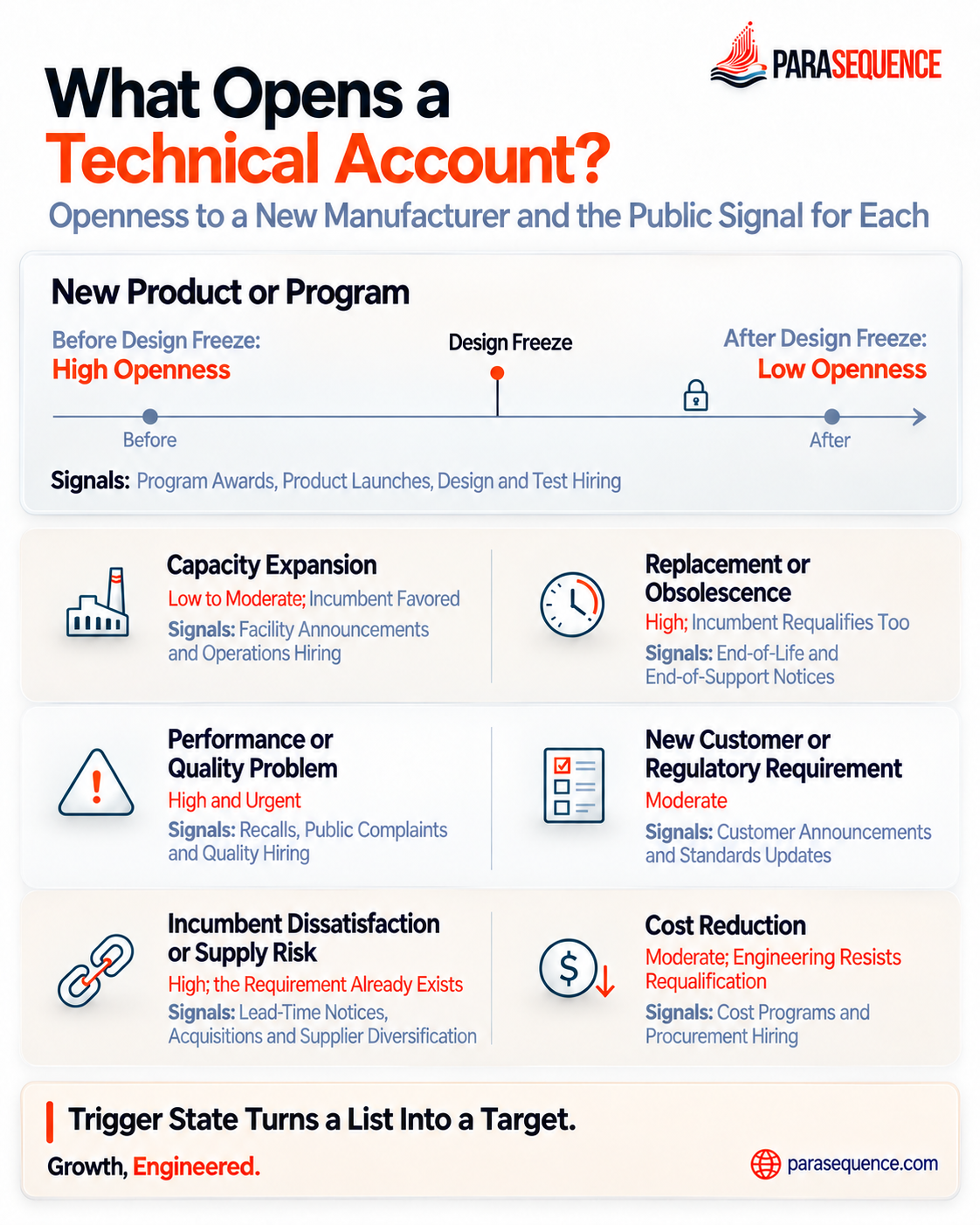
An evaluation starts with an event inside the customer's business, not with a marketing contact. The trigger determines how urgent the purchase is, who leads it and how open the buying group is to a company it has not bought from before. For a manufacturer, the trigger also decides which accounts are worth effort right now. That is why the target-account definition in technical markets has to include trigger state as well as industry and size.
Purchase Triggers and Public Signals
Scroll to view all columns ↔
| Trigger | Typical situation | Openness to a new manufacturer | Public signal |
|---|---|---|---|
| New product or program | New platform, machine design or product line | High before design freeze; low after | Program awards, product launches, design and test hiring |
| Capacity expansion | Second bench, additional line, new inspection cell | Low to moderate; incumbent favored | Facility announcements, operations hiring |
| Replacement or obsolescence | End of support; discontinued part | High; the incumbent must requalify too | Competitor end-of-life and end-of-support notices |
| Performance or quality problem | Yield loss, failed qualification, field returns | High and urgent | Recalls, public complaints, quality hiring |
| New customer or regulatory requirement | New test, inspection, traceability or qualification demands | Moderate | Customer and program announcements, standards updates |
| Incumbent dissatisfaction or supply risk | Slow service, missed deliveries, price increases, the incumbent acquired, a single source the customer wants to back up | High; the requirement already exists | Incumbent lead-time and price notices, acquisitions of the incumbent, supplier diversification programs |
| Cost reduction | Lower-cost alternative source sought by procurement | Moderate; engineering resists requalification | Cost-reduction programs, procurement hiring |
The triggers that create the most openness to a new manufacturer are the ones it is least likely to hear about through normal sales activity. They are visible, though, to anyone watching. When Emerson acquired National Instruments and Keysight acquired Spirent, customers of the acquired product lines had reason to review their options. A manufacturer watching could reach them before any inquiry was sent.
A target list defined as "test and measurement companies with 50 to 500 employees" treats an account about to run an evaluation the same as one that finished last year. Trigger state turns a list into a target, and monitoring it across a few hundred accounts is now routine with AI-assisted research.
3. The Buying Group: Personas, Decision Rights and Coverage
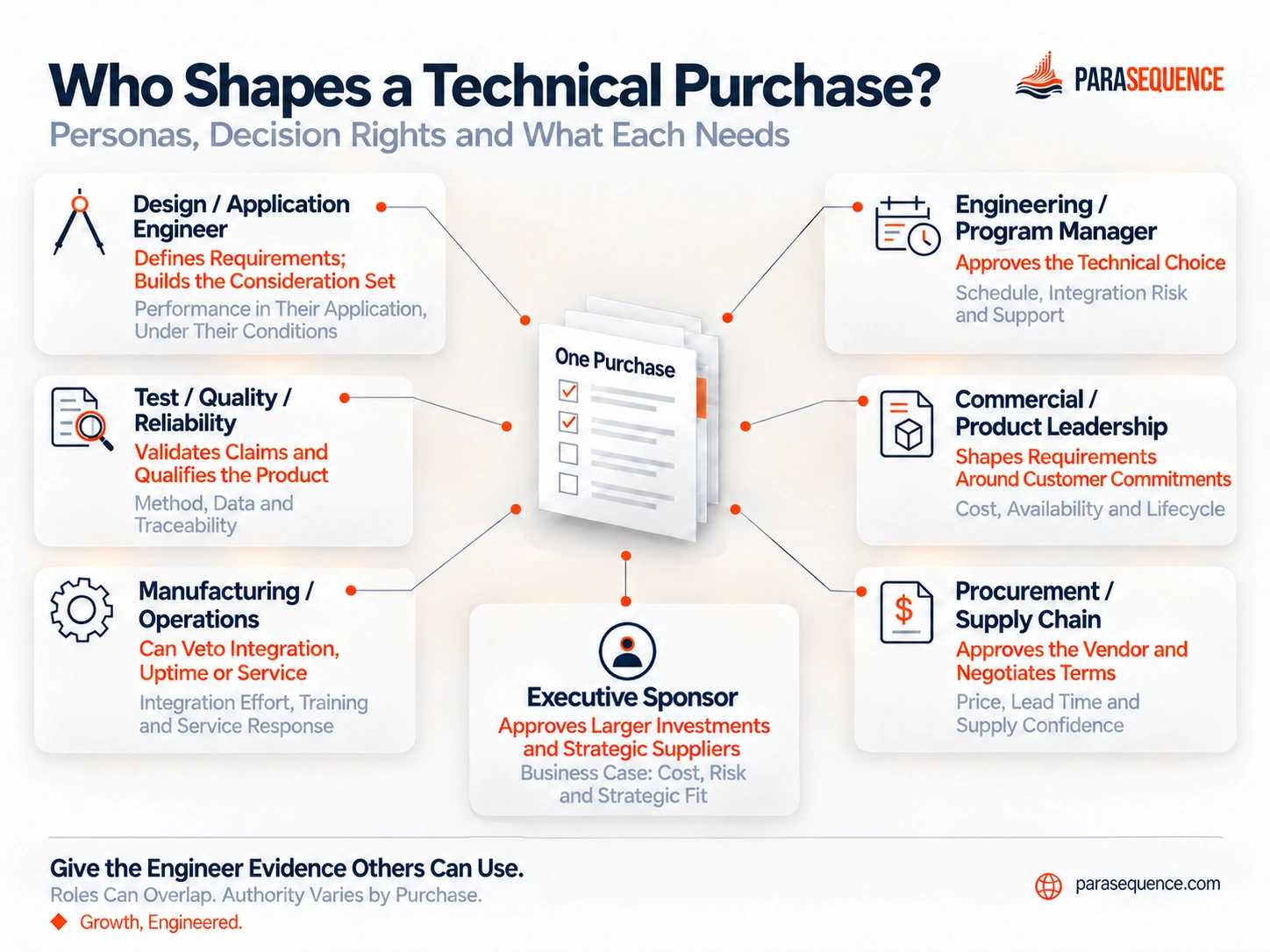
A technical purchase is seldom one person's decision, and the people who decide it are not all engineers. The number involved grows with purchase value and company size. At a 30-person machine builder the founder may be engineering manager and buyer in one. At a prime contractor several functions take part and more than one of them holds a veto. The engineer who starts the evaluation is only the first persona a manufacturer has to convince; the others judge the choice by their own criteria.
Buying-Group Personas and Decision Rights
Scroll to view all columns ↔
| Persona | Typical titles | Decision right | Needs before supporting a manufacturer | Reached through |
|---|---|---|---|---|
| Design or application engineer | Design, RF, controls, test or applications engineer | Defines the requirement; builds the consideration set | Evidence of performance in their application, under their conditions | Search, application notes, distributors, peers, samples |
| Test, quality or reliability engineer | Quality engineer, metrology lead, reliability engineer, lab manager | Validates claims; qualifies the product | Method, data, traceability, qualification history | Technical documentation, sample programs, audits |
| Engineering or program manager | Engineering manager, program manager, R&D director | Approves the technical choice; owns schedule and risk | Confidence in schedule, integration risk and support | Referrals, references, sales conversations |
| Manufacturing or operations | Manufacturing engineer, plant engineer, operations manager | Veto on integration, uptime or service | Integration effort, training, service response | Demonstrations, site visits, references |
| Commercial and product leadership | Product manager, sales director, commercial manager | Shapes the requirement where the product affects what the customer sells or promises | Cost, availability and lifecycle that support their own commitments | Customer references; reusable product and application material |
| Procurement and supply chain | Buyer, commodity manager, supply chain manager | Approves the vendor; negotiates terms | Price, lead time, financial stability, lifecycle commitment | RFQs, supplier portals, sales |
| Executive sponsor | CEO, founder, general manager, VP engineering | Approves larger investments and strategic suppliers | A business case: cost, risk, strategic fit | Senior relationships, peers, industry events |
Most technical marketing is written for the first row and stops there. The engineer can prefer a product and still lose the internal argument: the quality lead could not find qualification data, the commercial team saw a lifecycle risk to its own product, or procurement raised a supply concern nobody addressed. The preferred manufacturer loses without a single conversation taking place.
Two rules follow. Every persona needs material the engineer can forward internally, written for that persona's question, and coverage of a target account should match its organization: the roles, the people in them, and what each has seen. That mapping was a sales-only exercise; AI-assisted research now makes it practical across an entire target list.
4. Funnel Stages: Requirement, Market Scan, Screening, Validation, Qualification, Selection and Repeat
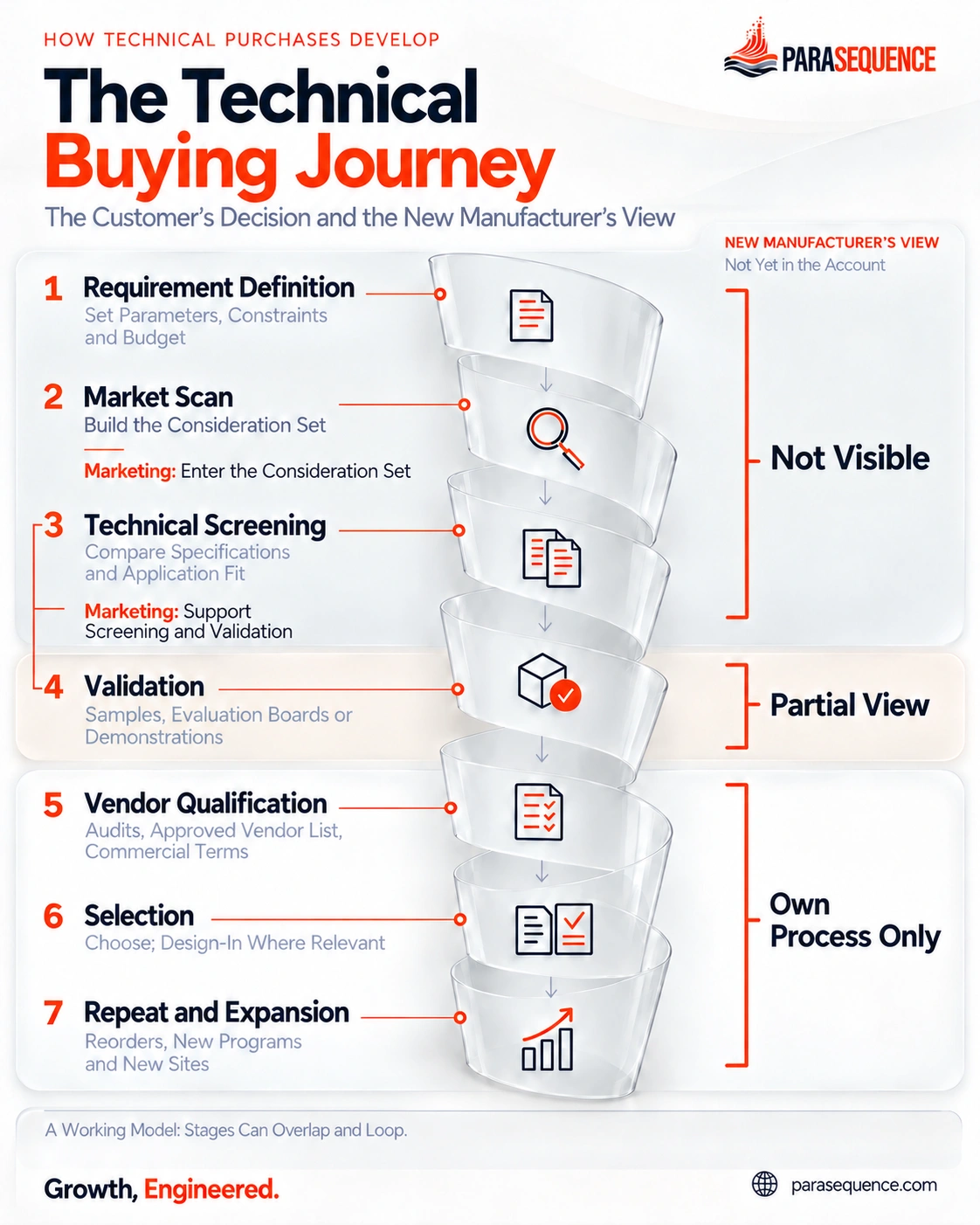
Not every purchase passes through every stage, few customers run them formally, and real evaluations loop and overlap rather than proceeding in order. The sequence below is a working model of a technical purchase, not a measurement. The table shows what the buying group is doing at each stage, what the manufacturer can see of it, and how manufacturers are dropped. The visibility column describes a manufacturer not yet in the account. The incumbent's applications engineer is often in the room while the requirement is written, which is how the consideration set is inherited.
Stages of a Technical Purchase
Scroll to view all columns ↔
| Stage | Buying-group activity | What the manufacturer can see | How a manufacturer is dropped here |
|---|---|---|---|
| 1. Requirement definition | Trigger translated into parameters, constraints and budget | None | Not known when the requirement is written |
| 2. Market scan | Consideration set built | None | Absent from the network, the channel and search |
| 3. Technical screening | Specifications and application fit compared | None | Specifications without conditions; no models or data |
| 4. Validation | Samples, evaluation boards, demonstrations, feasibility studies | Partial | Slow samples; thin applications support |
| 5. Vendor qualification | Audits, approved vendor list, commercial terms | Own process only | Documentation gaps; supply or lifecycle risk |
| 6. Selection and design-in | Final choice; for components, the part designed in | Own process only | Objection from a persona never addressed |
| 7. Repeat and expansion | Reorders, new programs, new sites | Own process only | A new trigger reopens the decision |
Two points carry most of the commercial weight.
Marketing has to be present at two places in this sequence: the market scan, where the consideration set is built and an absent manufacturer is never evaluated, and technical screening and validation, where the field narrows to the companies invited to quote. Most budgets fund the first through visibility spending, and the sales process at stages 5 and 6, and leave the middle to the product documentation. Covering both with the same discipline is the allocation change that matters most.
For designed-in products, selection at stage 6 secures production orders for the life of the customer's platform or machine. That makes presence while the requirement is written a commercial priority rather than a branding exercise.
5. Decision Touchpoints: Network, Channel Partners, Industry Events, Website, Search and AI Visibility
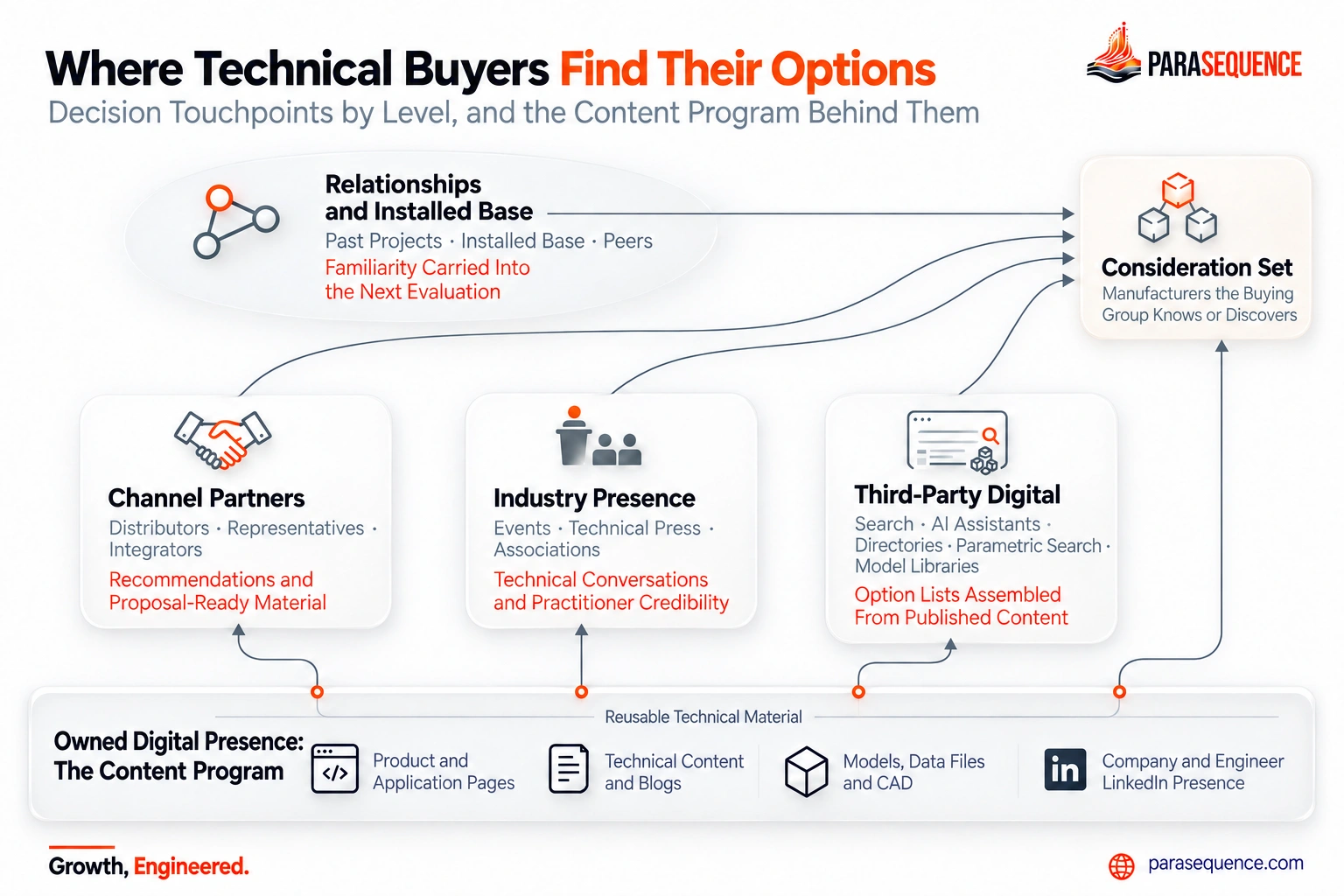
Every stage above happens somewhere: in a conversation between engineers, at a distributor, on a trade-show stand, in a simulation tool, on a product page, in a search result. These are the decision touchpoints, the map of where a manufacturer has to be present.
Before anyone evaluates a product in detail, the people involved already hold a view of the market. In an established category they know the main companies and have an opinion of each: the safe choice, the premium option, the small company with good engineers, the low-cost alternative. That view was built over years through the first three levels of touchpoints below, and it is carried into every new evaluation. The digital touchpoints mostly add names to that inherited view; they rarely replace it.
Decision Touchpoints and the Content Program
Scroll to view all columns ↔
| Level | Touchpoint | Role in the decision | Manufacturer's lever |
|---|---|---|---|
| Relationships and installed base | Installed base and past projects | Sets the default option | Product performance, service history, account relationship |
| Relationships and installed base | Peer network: colleagues, former colleagues, customers' engineers | Strongest source of recommendation | Reputation among people who have used the product |
| Channel partners | Distributors and manufacturers' representatives | First call for many component buyers; decide which lines are shown | Line priority, partner training, complete product data, representative enablement |
| Channel partners | System integrators | Select components on the end customer's behalf | Integrator relationships, proposal-ready material |
| Industry presence | Trade shows and conferences (IMS, Automate, The Vision Show, Pittcon, DesignCon, the Quality Show) | Side-by-side comparison; direct access to applications teams | Applications and engineering staff on the stand; technical sessions |
| Industry presence | Technical press and industry associations | Credibility among practitioners | Technical articles, standards participation, association activity |
| Owned digital presence | Product pages | Specification comparison | Conditions stated with every specification |
| Owned digital presence | Application and industry pages | Application fit in the buyer's own terms | One page per priority application or industry |
| Owned digital presence | Technical content and blog, with internal linking | Requirement-stage education; search and AI visibility | Selection guides and application notes linked to product and application pages |
| Owned digital presence | Models, data files and CAD | Entry into design and simulation tools | Complete, current models in the formats the market uses |
| Owned digital presence | LinkedIn company and employee presence | Signals activity, credibility and technical substance | Consistent technical posting by the company and its engineers |
| Third-party digital | Search engines | Requirement and part-number searches | Content that matches how buyers describe the problem |
| Third-party digital | AI assistants | Option lists assembled from published, cited content | Public technical content an assistant can read and attribute |
| Third-party digital | Directories, parametric search and model libraries | Parameter filtering and models pulled into design tools before any contact | Complete third-party product data; presence in the libraries the market's engineers use |
The owned rows are the content program; the channel and industry levels reuse it. Product and application pages, technical content, models and the company's LinkedIn presence, kept current and linked to one another, are what search engines and AI assistants read. They decide whether a manufacturer is added at the scan at all.
Two consequences follow for smaller manufacturers. They are usually not rejected; they are never considered, because the inherited view did not include them. And entering that view in a target account takes repeated presence across several touchpoints over time: a program, not a campaign, run with the same discipline as the sales process. How search engines and AI assistants assemble their option lists, and how pages are written to appear in them, is covered in our guide to SEO and AEO for technical B2B manufacturers.
6. The Buying Journey by Industry: Test & Measurement, Motion Control, RF & Microwave, and Vision, Metrology & NDT
The stages and touchpoints are common to technical markets. Who leads the evaluation, what decides it and what holds the consideration set in place differ enough that a plan built for one industry usually fails in another. The four illustrations below are composites, not client accounts, and the cycle lengths in the table are typical ranges rather than measurements.
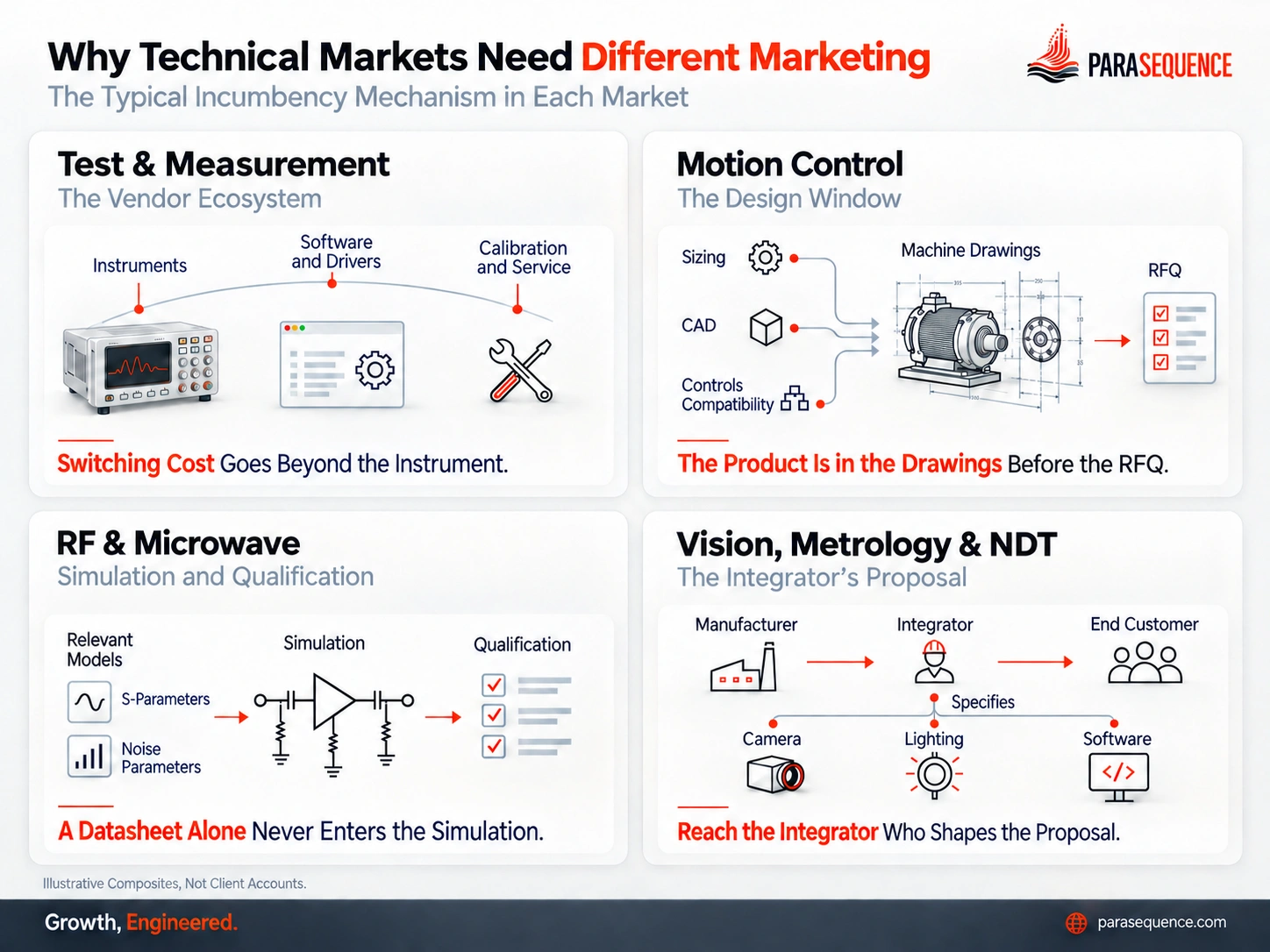
Test and measurement: the ecosystem decides the second bench. A laboratory adding capacity for a new validation program needs another signal analyzer. The test engineer has used the incumbent's instruments for a decade, the lab's automation runs on that vendor's software and drivers, and calibration is on a service contract. The evaluation lasts a week and never leaves the incumbent's catalog. A manufacturer with a better instrument for the application was never considered, because it offered no answer to the cost of leaving the ecosystem.
Motion control: the design window closes early. A machine builder starts a new wafer-handling platform. During architecture work, the mechanical engineer sizes the stages with a tool from a manufacturer he knows from a previous employer, downloads the CAD, and designs the mounting around it. The controls engineer checks drive compatibility with the controller already selected. By the time purchasing issues an RFQ, the stage is in the drawings.
RF and microwave: the model is the datasheet. An RF design engineer on a new radar program needs a low-noise amplifier that holds its noise figure across temperature. She lists the vendors she knows and pulls S-parameter and noise-parameter models from the ones that publish them into her simulator. She checks which of them publish measured noise figure across temperature, and asks the distributor's applications engineer about a fourth name he does not carry. The vendor with only a PDF datasheet never enters the simulation, and the qualification file decides what happens after it.
Vision, metrology and NDT: for the inspection cell, the integrator is the buyer. A Tier 1 automotive supplier's quality engineer is asked to add 100 percent inspection of a machined housing after a customer escape. She calls the integrator that built the line. The integrator proposes the camera, lighting and software brands it knows, Cognex and Keyence at the top of the list. It runs a feasibility study on sample parts and quotes a cell. A specialist lighting or sensor manufacturer with a better answer for that surface never reached the integrator, so it never reached the line.
The Buying Journey by Industry
Scroll to view all columns ↔
| Test & Measurement | Motion Control | RF & Microwave | Vision, Metrology & NDT | |
|---|---|---|---|---|
| Product category | Instruments and test systems | Stages, actuators, motors, drives | Components and subsystems for radio, radar, satellite and test | Inspection and measurement systems |
| Purchase model | Capital purchase on a multi-year replacement cycle | Design-in, then production orders for the life of the machine | Design-in with qualification, then program-life orders | Integrator-built cell (vision); capital purchase, direct or through distributors (metrology); capital or rental (NDT) |
| Lead persona | Test engineers, lab managers | Mechanical and controls engineers | RF design and component engineers, program managers | Quality and manufacturing engineers, system integrators, NDT Level IIIs |
| Decision criteria | Application capability, software and automation fit, calibration, service | Move-profile and machine fit, controls integration, supply continuity | Measured performance across conditions, qualification, export classification, lifecycle | Feasibility on the customer's parts, integration effort, cost of a missed defect |
| Channel structure | Direct and distribution, strong vendor ecosystems | Distributors, integrators, sizing tools, CAD libraries | Distributors, parametric search, simulation models, evaluation boards | Integrators, distributors, rental houses, trade shows |
| Evaluation cycle (typical range) | Weeks to months, tied to budget cycles | Six to twelve months, tied to machine development | Six to eighteen months where qualification applies | Three to six months, including feasibility |
| Typical incumbency mechanism | Ecosystem: software, drivers, service | Design window: sizing tools, CAD, the engineer's memory | Simulation gate and qualification file | The integrator's proposal; the lab's software and fixtures; the written procedure |
| Typical loss point for smaller manufacturers | No answer to the ecosystem switching cost | Absent during design | No models at the simulation stage | Never reached the integrator, the quality lab or the Level III |
Treating technical B2B as one market, with one plan, is among the most common reasons marketing investment in these companies underperforms. Each of the four markets has its own guide: test and measurement, motion control, RF and microwave, and vision, metrology and NDT.
7. Evidence-Led Positioning: Application, Industry, Product and Company Advantages, and the Proof Each Requires
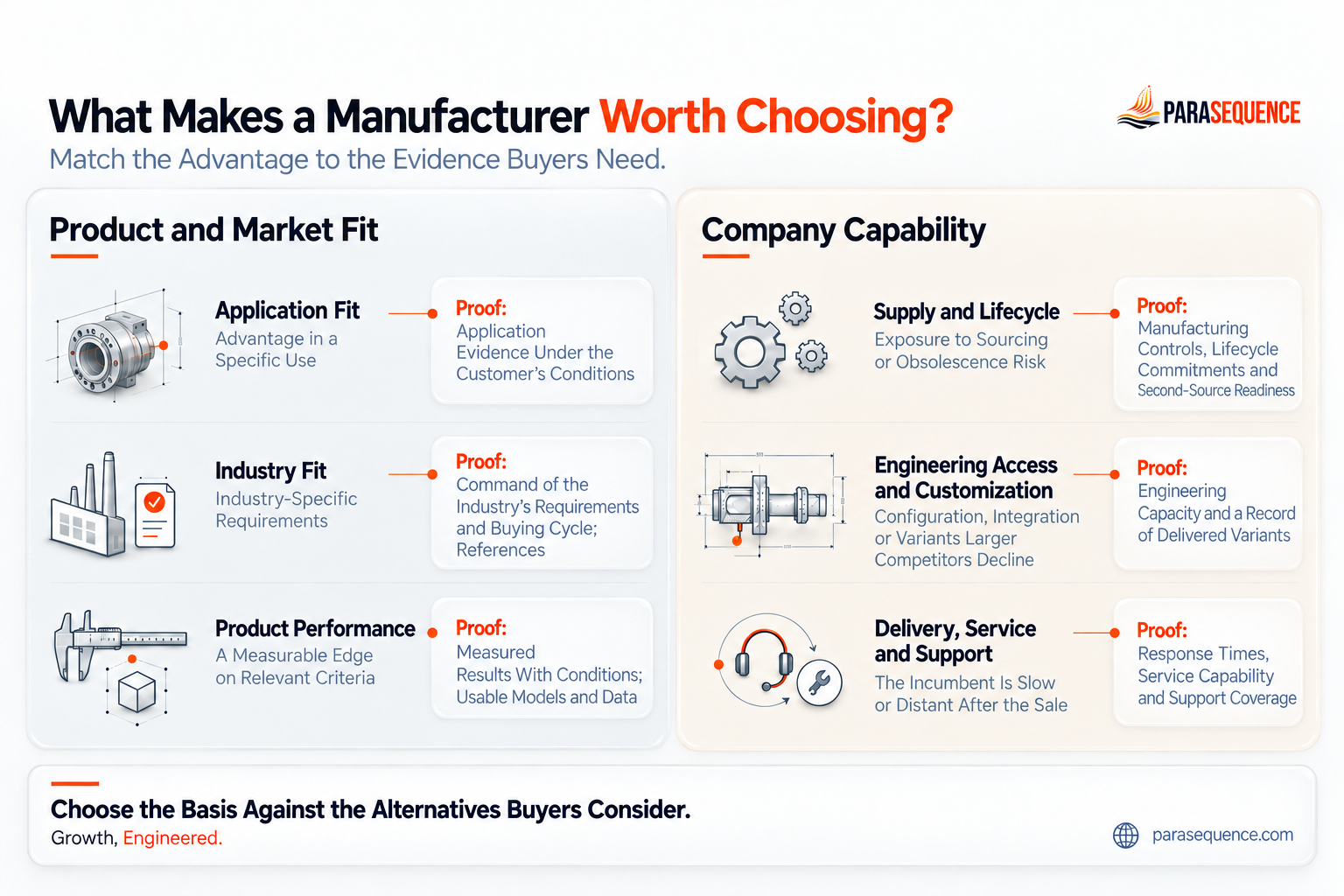
A manufacturer cannot be present at every touchpoint for every customer. Positioning decides where it will be present and on what basis it expects to be chosen: which market, industry or application, against which alternatives, on which advantage. The basis is wider than the product.
Positioning Bases and Required Evidence
Scroll to view all columns ↔
| Positioning basis | Market condition | Required evidence |
|---|---|---|
| Application fit | Demonstrable advantage in one use, within one industry or across several | Application evidence under the customer's conditions |
| Industry fit | Requirements shaped by the industry's standards, programs or qualification regime | Command of the industry's requirements and buying cycle; references |
| Product performance | Measurable edge on criteria the buying group already uses | Measured results with conditions; models and data the customer can use |
| Supply and lifecycle | Customers exposed to lead-time, obsolescence or sourcing risk | Controlled manufacturing, lifecycle commitments, second-source readiness |
| Engineering access and customization | Configuration, integration or variants that larger competitors decline | Applications engineering capacity; record of variants delivered |
| Delivery, service and support | Incumbent slow or distant after the sale | Response times, service capability, support coverage |
The right basis depends on the alternatives the buying group considers. Where performance has become comparable across competitors, positioning on it alone leaves price to decide, and the stronger basis is usually supply, access or support. Where the product has a measurable edge in one application, that application is where to start and the rest of the plan follows.
Whatever the basis, the buying group needs the same evidence at every touchpoint; only the format changes with the touchpoint and the persona.
Evidence for the Buying Group
Scroll to view all columns ↔
| Evidence element | Buying question it answers | Primary persona |
|---|---|---|
| Application in the customer's terms | Does this company work on my problem? | Design or application engineer |
| Requirements with their conditions | Does it meet my requirement under my conditions? | Design engineer, quality |
| Measured results, method and limits | Can the claim be trusted, and where does it stop? | Quality, reliability, program management |
| Scope of supply | What else do I need, and what will it cost? | Operations, procurement |
| Support, lead time and lifecycle | Is this company safe to choose? | Procurement, commercial leadership, executive sponsor |
| Next step sized to the stage | How do I move forward without entering a sales process? | Whoever leads the evaluation at that stage |
Most manufacturers already hold all of this, with applications engineers, in test reports, in the support inbox, in lost-evaluation notes and in recent quotes. Collecting it is the first marketing task, because it settles the positioning. The second is to move it into the forms the buying group uses, keep every claim within what the evidence supports, and have engineering approve it before publication.
8. Allocating Marketing Effort Across the Journey: Decisions, Metrics, Sales Alignment and Presence Between Triggers
The journey leads to six allocation decisions. Each addresses a stage of the journey, each is a choice about where effort and budget go, and each has a leading measure that shows whether it is working. Some of those measures are read from the CRM; the ones about the market scan are estimates built from sales and channel reports.
Marketing Allocation Decisions and Leading Metrics
Scroll to view all columns ↔
| Decision | Journey stage addressed | In practice | Leading metric |
|---|---|---|---|
| Which job marketing is doing | Market scan, or screening and validation | Enter consideration sets, or win the evaluations the company is already in | Estimated share of target accounts aware; estimated share of category evaluations entered |
| Presence at the market scan | Market scan | Technical content program, search and AI visibility, LinkedIn company and engineer presence, trade shows, distributor and integrator enablement | Target accounts reached across touchpoints; category search and AI-assistant visibility |
| Target accounts by trigger | Requirement definition | Accounts with a live trigger prioritized over the rest of the list | Outreach share to triggered accounts; their response rate against the rest |
| Buying-group coverage | Screening through selection | Material per persona; several contacts per account; distributors, representatives and integrators briefed | Personas reached per target account; partner material in use |
| Screening and validation support | Technical screening and validation | Application content with conditions, selection guides, models and data, sample programs, applications engineering time | Application-content engagement by target accounts; samples and evaluations started |
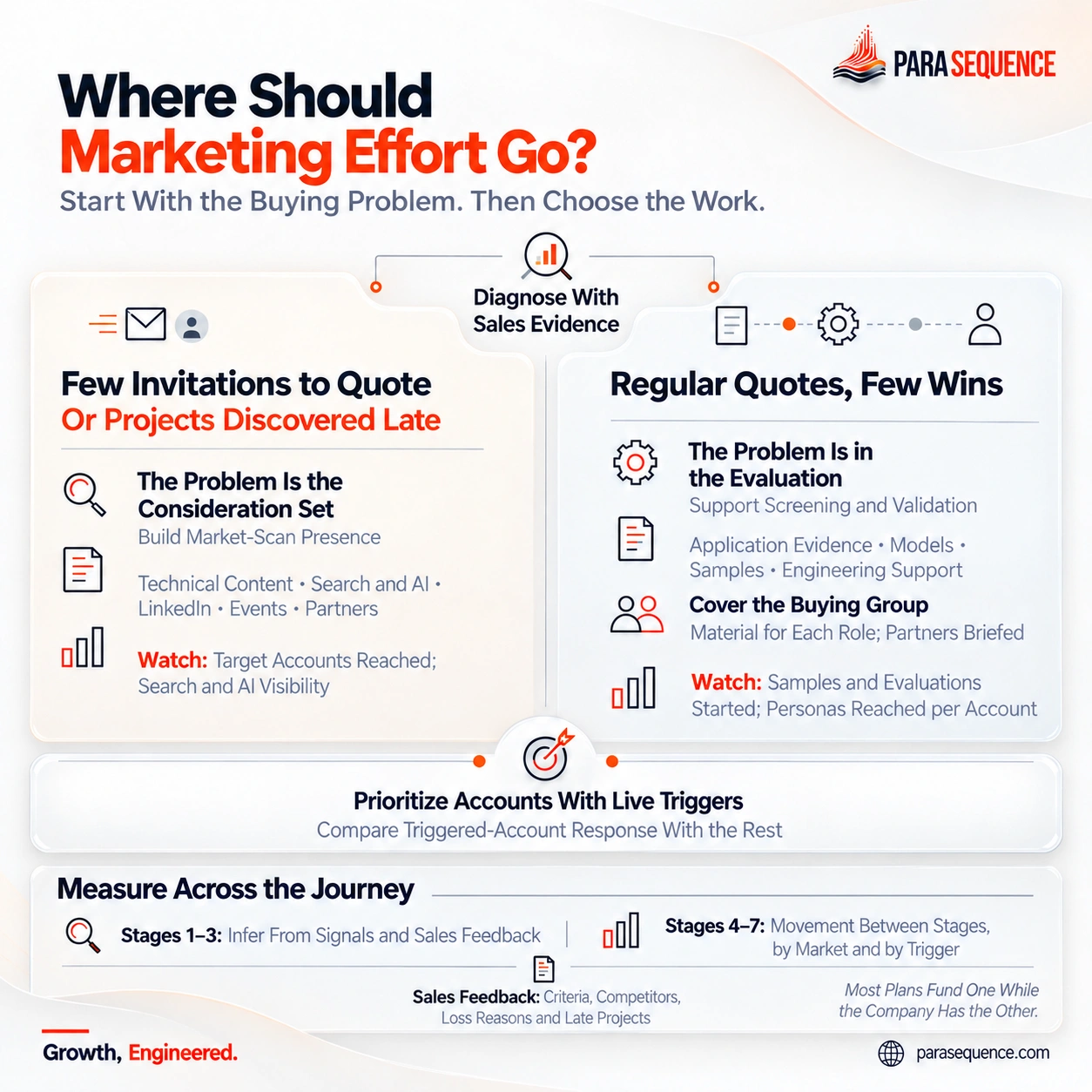
| Stage-based measurement | All stages | The journey tracked instead of the lead count | Movement between stages 4 to 7, by market and by trigger; stages 1 to 3 inferred from trigger monitoring and sales feedback |
A sales team can usually diagnose the first decision without new data. If the company is asked to quote often and wins few of those evaluations, the problem is in the evaluation. If it is seldom asked, or learns about projects mainly after a competitor has been chosen, the problem is the consideration set. The two call for different programs; most plans fund one while the company has the other.
Sales alignment. Marketing hands sales the account context it has built; sales returns what only it hears: the criteria used, the competitors named, why an evaluation was lost, the projects discovered late. That is the only direct evidence of the invisible evaluation a company receives, and few CRMs record it.
Presence between triggers. Most target accounts have no trigger at any given time. The task is to be present when it arrives: a program measured in quarters, not an email sequence measured in days. Stage-level measurement shows where evaluations stall, and that is what tells a CEO where the next dollar of marketing should go. The measurement system behind the six decisions is set out in our guide to B2B marketing metrics for technical manufacturers.
9. Working With ParaSequence
ParaSequence plans and runs marketing for manufacturers and suppliers of complex technical products. For one priority market, we map the buying journey as it applies to the product and settle the positioning with the company's leadership. Then we build the evidence and buying-group coverage, and run the demand programs and sales alignment that follow from them.