
Sector Guide · Test & Measurement
B2B Marketing for Test & Measurement Companies
How engineers find and evaluate test equipment — and the marketing system, awareness to MQL, that an instrument maker runs to be found first.
How engineers find and evaluate test equipment — and the marketing system, awareness to MQL, that an instrument maker runs to be found first.
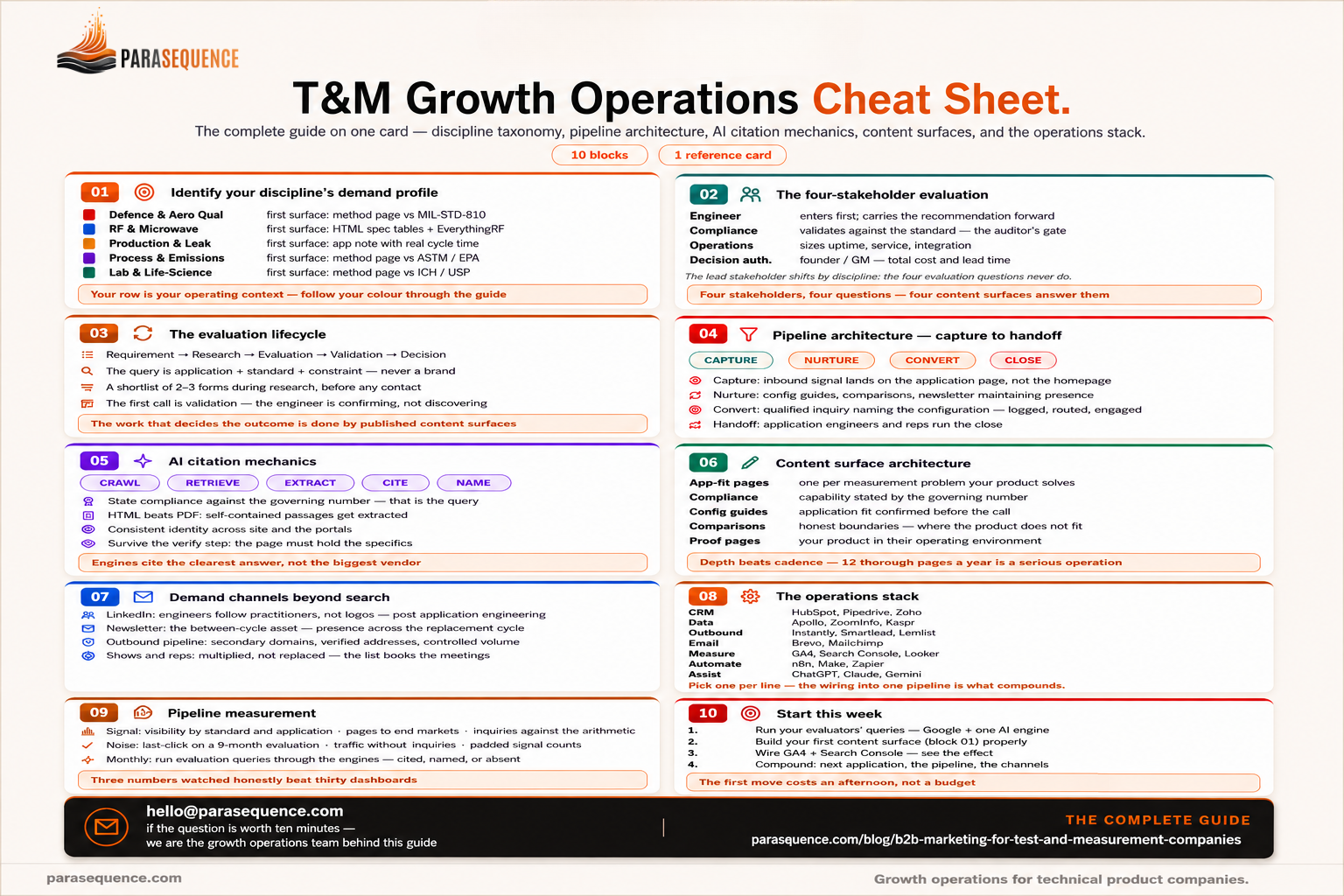
If you make test and measurement equipment, this guide covers both halves of the problem: the market you sell into — the families the sector is made of, the environments an instrument ends up in, the people who sign off, the way a purchase actually gets decided — and the marketing system that reaches it, from the first search an engineer runs to the qualified inquiry that lands on your sales desk.
It is written for everyone in that room: the founder who signs the marketing budget, the sales lead who needs the pipeline, the marketing manager who runs the system, and the engineers whose knowledge ends up in it. It is organised the way the sector organises itself, so that an oscilloscope maker, a shaker maker, a leak-tester maker and a chromatograph maker each find their own row — and it says where the map stops.
Test and measurement is one of the broadest categories in technical manufacturing. The companies in this sector build the instruments that other manufacturers rely on to develop, qualify, and produce their own products. Getting the sector’s own map right is the first job of a marketing plan, because your customers search along it.
Four families. The first is the largest by revenue and the one every public test-and-measurement company sits in.
Electronic and RF test — the bench and general-purpose instruments (oscilloscopes, multimeters, source-measure units, programmable power supplies, electronic loads, logic analyzers, probe stations); RF, microwave and wireless test (spectrum and signal analyzers, vector network analyzers, signal generators, power meters and sensors); EMC, antenna and over-the-air test (EMI receivers, immunity generators, antennas, shielded and anechoic chambers); data acquisition and modular instrumentation (DAQ, PXI, signal conditioning and the software around them); and optical and laser measurement (laser power meters, beam profilers, spectroradiometers).
Physical and environmental test — materials and mechanical testing machines (tensile and compression frames, hardness, fatigue, impact, rheometers, and the grips and extensometers sold with them); vibration, shock and NVH systems (shakers, amplifiers, controllers, modal analysis); environmental chambers (temperature and humidity, thermal shock, altitude, salt fog, HALT/HASS); measurement sensors and transducers (load cells, torque and pressure transducers, accelerometers, strain gauges); and gaging and dimensional metrology (air gaging, thread and plug gages, height gages, gage blocks, surface plates).
Production, reliability and calibration — production and functional test (end-of-line testers, in-circuit and flying-probe test, burn-in, leak and seal-integrity test, hardware-in-the-loop); machine condition monitoring (portable vibration analyzers, online monitoring, machinery protection); and calibration instruments and standards (calibrators, deadweight testers, temperature baths, decade boxes, reference meters).
Analytical and application instruments — analytical and laboratory instruments (spectroscopy, chromatography, mass spectrometry, thermal analysis, particle sizing); battery and energy-storage test (cyclers, formation, impedance, abuse chambers); electrical power, grid and high-voltage test (hipot, relay test sets, partial discharge, transformer and breaker test); and radiation and nuclear instrumentation (survey meters, portal monitors, spectroscopy detectors).
Two notes keep the map honest. A set of companies sells instrument components and OEM subsystems — RF attenuators and switches, amplifiers, signal-conditioning modules, precision references — to the instrument makers above rather than to end users. Everything in this guide applies to them with one substitution: their buyer is the design engineer at another instrument company. And process and field instrumentation — pressure, temperature, level and flow transmitters, gas detection, water-quality and in-stream analyzers sold to plant engineers — is a separately named industry with its own buying motion. It is not covered here; a maker who straddles that line should decide which side its revenue sits on before building a content plan for either.
The same instrument serves engineers in very different places — and the environment it lands in shapes everything about how it is bought.
| End Environment | What Gets Tested | Instruments From This Sector | What Drives the Purchase |
|---|---|---|---|
| Semiconductor fabs and process | Device characterisation, trace contamination, tool qualification | Source-measure units and probe stations, RF and high-speed test, analytical instruments for materials and contamination | Node shrink, fab expansion, contamination control |
| Medical device manufacturing | Package and seal integrity, sterilisation validation, materials | Leak and seal-integrity testers, environmental chambers, materials testers | Regulatory validation, traceability, audit requirements |
| Automotive and EV | Cells and packs, motors, NVH, structural durability, end-of-line | Battery cyclers, shakers, DAQ, end-of-line and functional test | Cycle time, throughput, platform investment |
| Aerospace and defence | Qualification to MIL-STD and DO-160, EMC, flight test, structures | Shakers and chambers, EMI receivers and immunity systems, DAQ and telemetry, materials testing | Standards compliance, documentation depth, programme schedules |
| Petrochemical and refining | Fuel and lubricant properties, asset condition, electrical plant | At-line analytical instruments, condition monitoring, HV test (the in-stream process instruments belong to the neighbouring industry) | Hazardous-area certification, field serviceability |
| Grid, utility and high-voltage | Insulation, transformer and breaker condition, power quality | HV test sets, partial-discharge measurement, power-quality analyzers, condition monitors | Grid modernisation, data-centre power buildout |
| Research and university labs | Varies by field | Broad — spectrometers, DAQ, materials testers, source-measure units | Grant budgets, flexibility, software ecosystem |
| Electronics production | Functional test, first-pass yield, safety compliance | Functional testers, ICT, boundary scan, hipot | Speed, automation interfaces, yield |
Demand across these environments is uneven, and it moves — defence and space programmes, semiconductor buildout, grid and data-centre power are pulling hard; some slices that were hot two years ago are not. The point for a marketing plan is not to forecast the sector; it is that your in-market count is set by which environments you serve, and the funnel section below gives you the arithmetic to compute it on your own numbers.
Two axes describe every company in this sector: what you make, and where it ends up. What you make places you in one of the four families above — that is your identity, and it decides how your buyers search, what evidence they need, and which page you should build first. Where it ends up is the second axis, and most makers span several destinations: a chamber maker sells into an aerospace qualification lab, a battery lab and a pharmaceutical stability lab in the same quarter, and each of those buyers evaluates against a different document.
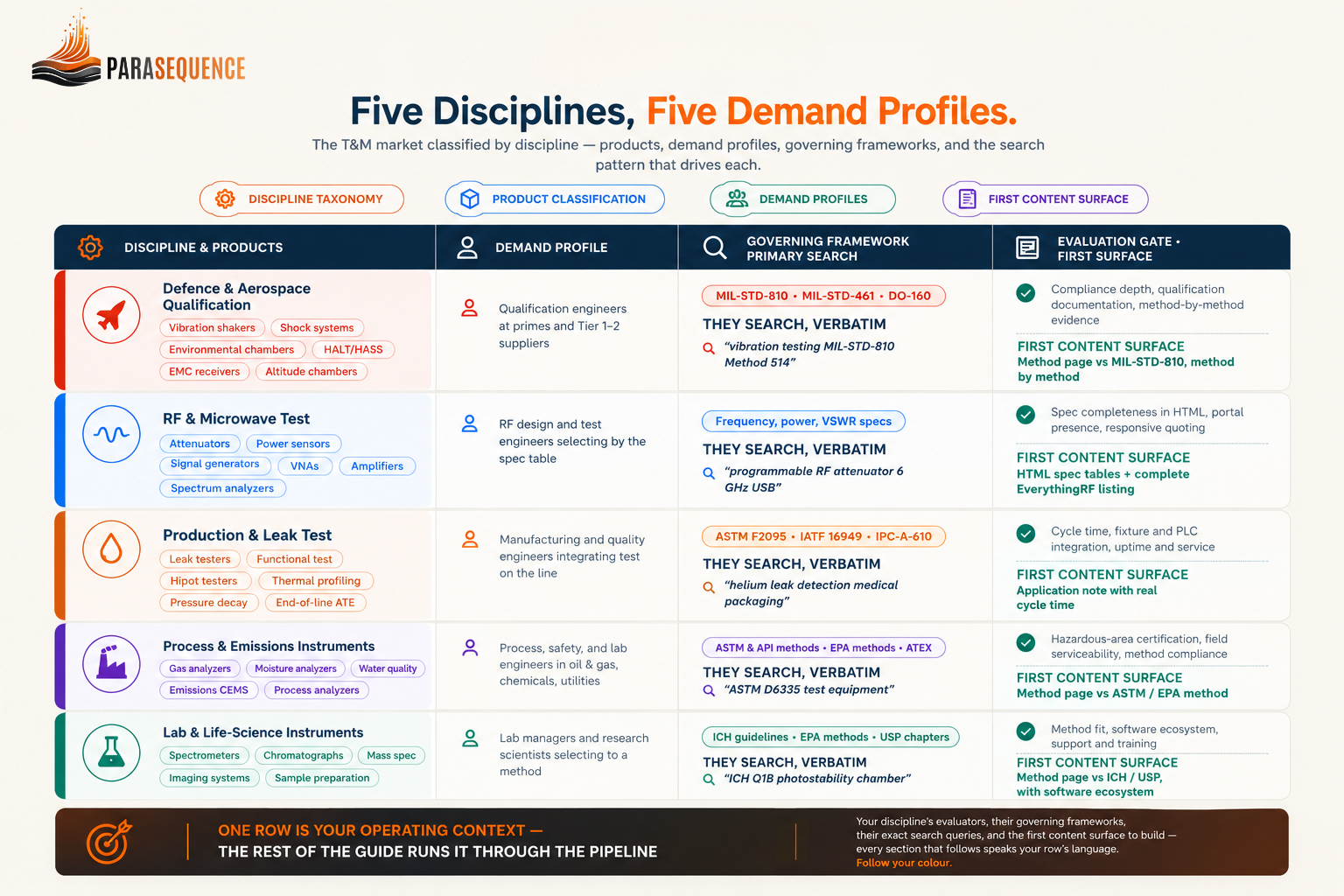
| Your Family | Your Buyers | What They Evaluate You On | What Drives Their Search |
|---|---|---|---|
| Electronic and RF test | Design and test engineers; compliance engineers for EMC | Spec completeness in HTML, drivers and software, portal presence; for EMC, standard-by-standard coverage | The spec line — and, for EMC, the standard number |
| Physical and environmental test | Test, materials, reliability and qualification engineers | Method compliance with documentation depth; for sensors and gages, accuracy class and the calibration certificate | The method or standard number; the accuracy class |
| Production, reliability and calibration | Manufacturing, quality and reliability engineers; metrology engineers | Cycle time and integration; uptime and service; stated uncertainty | The application on the line; the asset; the uncertainty |
| Analytical and application instruments | Lab and process engineers buying to a method; battery, power and health-physics engineers | Method fit and software; channel count and safety; kV rating and standard compliance | The method number; the spec plus the safety standard |
Find your row. The rest of this guide runs it through the buying journey, the funnel, the search engines, the content plan and the tools — where the answer differs by family, it is called out. Then run your row across your environments: that is where your application pages come from.
Every instrument serves more than one environment. That single fact drives most of what is unusual about marketing in this sector.
A helium leak tester is bought by a medical-device manufacturer verifying package and seal integrity and by an automotive production engineer checking powertrain seals. The specification sheet is the same. The customer is not.
The medical-device buyer is validating: a documented protocol, a recognised test method for the leak test itself, the sterile-barrier framework his packaging must satisfy, traceability to a calibrated reference, and an audit trail his quality system can defend. He needs to see that the instrument has been used in this exact context before. The automotive buyer is solving a throughput problem — cycle time under fifteen seconds, fixture compatibility with his line, parts per hour at production speed.
One product, two completely different purchases. The instrument maker who writes one message for both is, in practice, addressing neither.
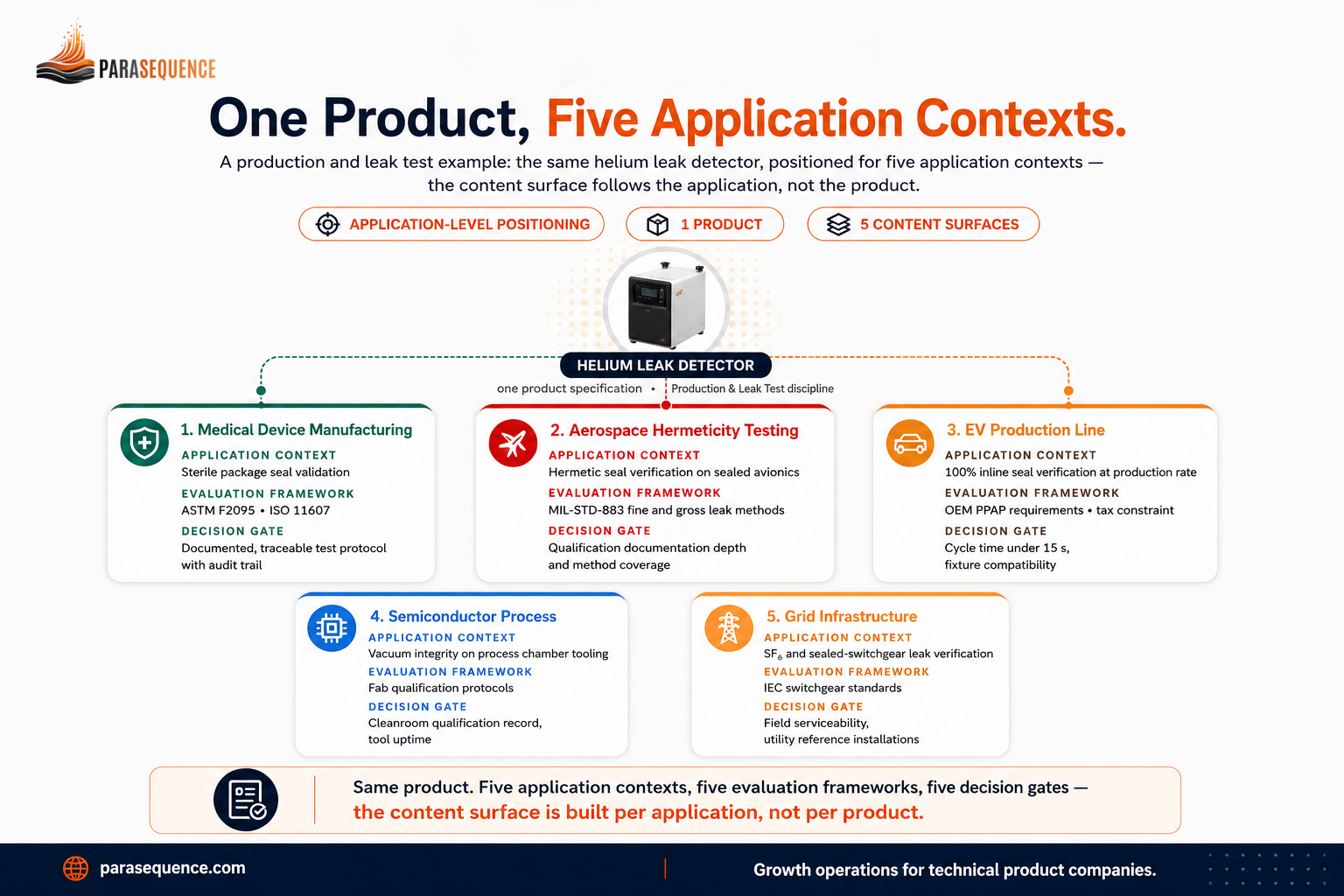
The pattern repeats across every family. A vibration system evaluated for MIL-STD-810 qualification is judged on method coverage and documentation; the same system evaluated for EV end-of-line is judged on takt time and automation. A data-acquisition system on a flight-test programme is judged on channel count, synchronisation and ruggedisation; in a battery lab, on isolation and safety integration. Run the arithmetic on your own catalogue: five end environments, one generic product page — four buyers reading a page that was not written for them.
How many people sign off depends on your customer’s size, not on yours. Many instrument makers under fifty million in revenue sell mostly to companies far larger than themselves — primes, OEMs, fabs, pharmaceutical manufacturers — and the group in the room looks different at each end.
| Your Customer | Who Researches | Who Validates | Who Signs | What That Means for You |
|---|---|---|---|---|
| A smaller manufacturer up to a few hundred people |
The engineer with the measurement problem | A quality hat — often the same engineer’s manager | The founder, GM or VP, who is the capital gate | The engineer is champion and near-signer; total cost and lead time close it |
| A large OEM, prime, fab or pharma plant | The requesting engineer | Engineering manager, quality or compliance, often metrology or calibration | Procurement runs the RFQ — frequently three quotes — with capital approval above a threshold | The engineer still builds the shortlist before anyone contacts you; the champion now needs evidence that survives procurement and an auditor |
What does not change with size is the mechanism. The search starts with a measurement problem, not a vendor. The shortlist forms before contact. The first call is validation, not discovery. And the engineer who found you is the champion — he carries the recommendation into meetings where you are not present, and the signer at the end asks a different question than he did at the start: not “does it measure correctly?” but “what does it really cost?” On an instrument the honest answer runs well past the sticker once fixturing, calibration, training and service are counted.
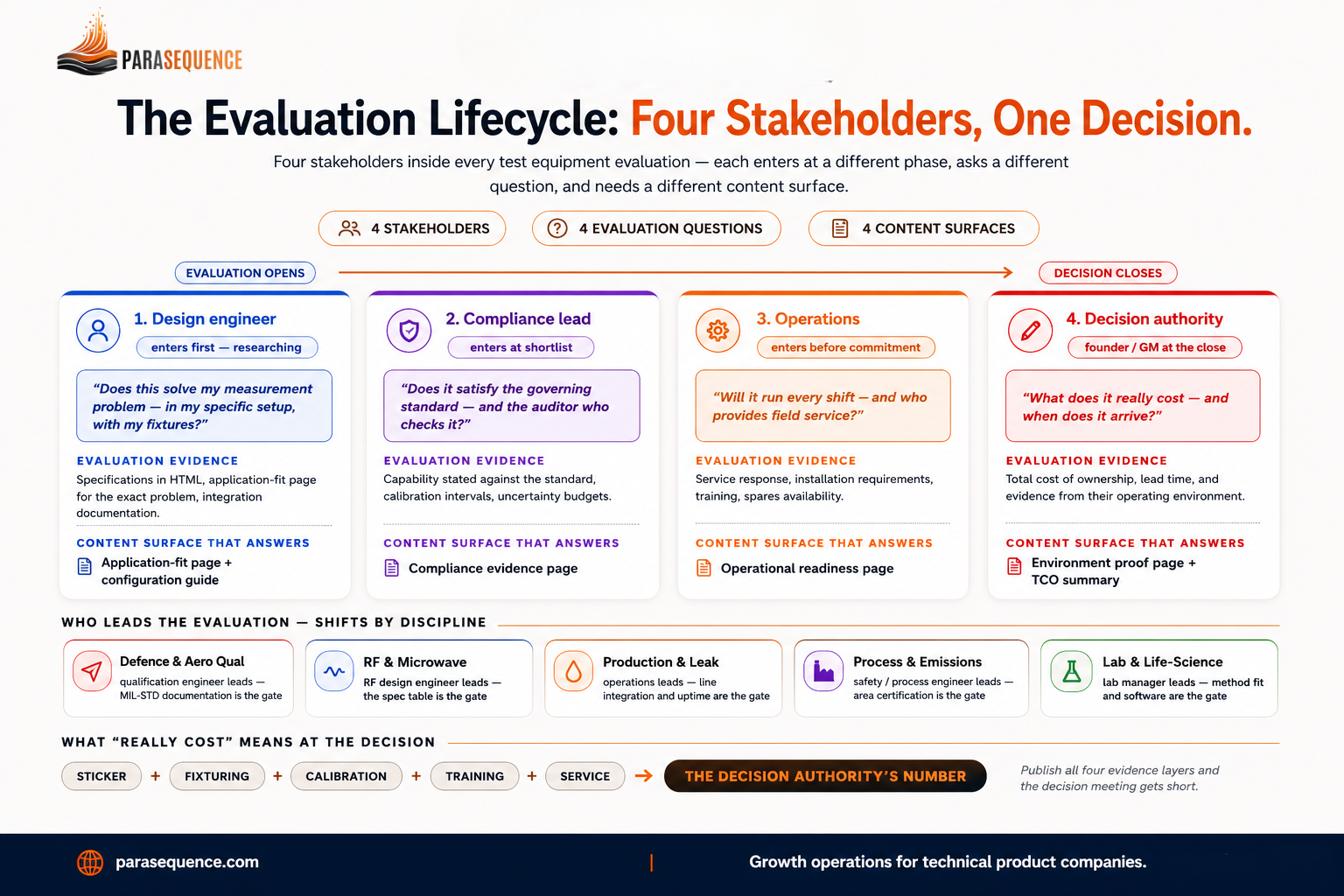
Whether your champion walks into that meeting equipped is something you decided months earlier — by what you published.
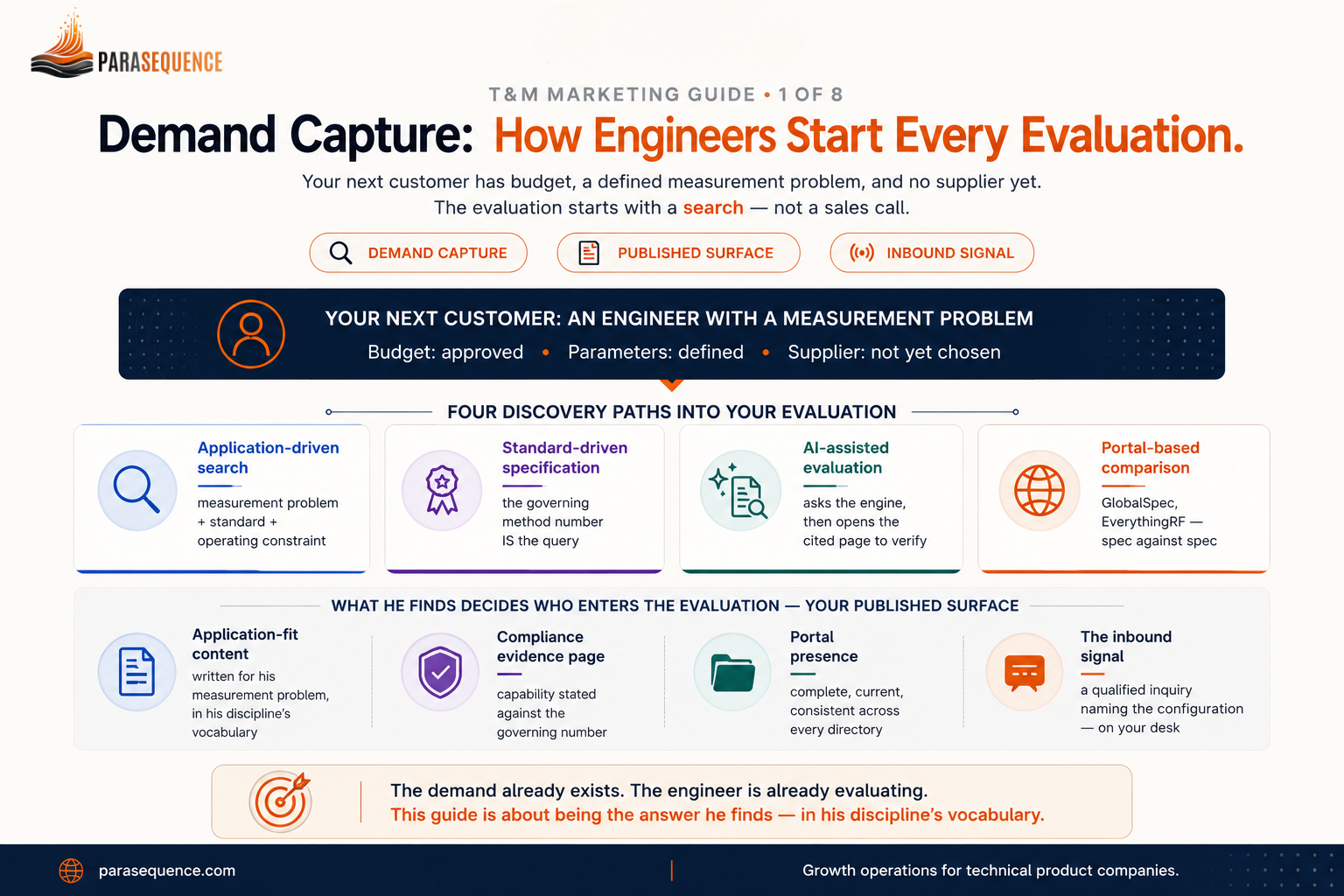
The search almost always starts with a measurement problem in a specific context — not with a product name, and not with a vendor.
Real searches in this sector look like:
In the standards-driven families the search is the standard. A qualification engineer searching “MIL-STD-810 Method 514” is not browsing — he is specifying. A materials lab searching “ASTM E8 tensile” has already defined the fixture set. A stability lab searching “ICH Q1B chamber” has defined the instrument. Instrument makers whose pages reference these documents by name and number appear in these searches. Those who describe the same capability in general terms do not.
In the spec-driven families the search is the parameter line — bandwidth, frequency range, channel count, accuracy class — and it runs as much through the sector’s portals and directories (GlobalSpec, EverythingRF, Thomasnet) as through Google. For RF and electronic test especially, these platforms carry real evaluation traffic: engineers comparing specifications across vendors, side by side. A structured, complete listing there is part of being findable.
How the search runs differs by family — and the difference decides what you publish first:
| Your Family | The Search Is Driven By | A Real Query Looks Like |
|---|---|---|
| Electronic and RF test | The spec line — and the portals; the standard number for EMC | “USB vector network analyzer 6 GHz” · “MIL-STD-461 RE102 test setup” |
| Physical and environmental test | The method or standard number; the accuracy class for sensors and gages | “tensile tester ASTM D638 5 kN” · “load cell 10 kN 0.02% NIST traceable” |
| Production, reliability and calibration | The application on the line; the asset class; the stated uncertainty | “helium leak test medical device package” · “deadweight tester 0.008% uncertainty” |
| Analytical and application instruments | The method number; the spec plus the safety or test standard | “EPA Method 200.9 graphite furnace AA” · “battery cycler 5 V 100 A regenerative” |
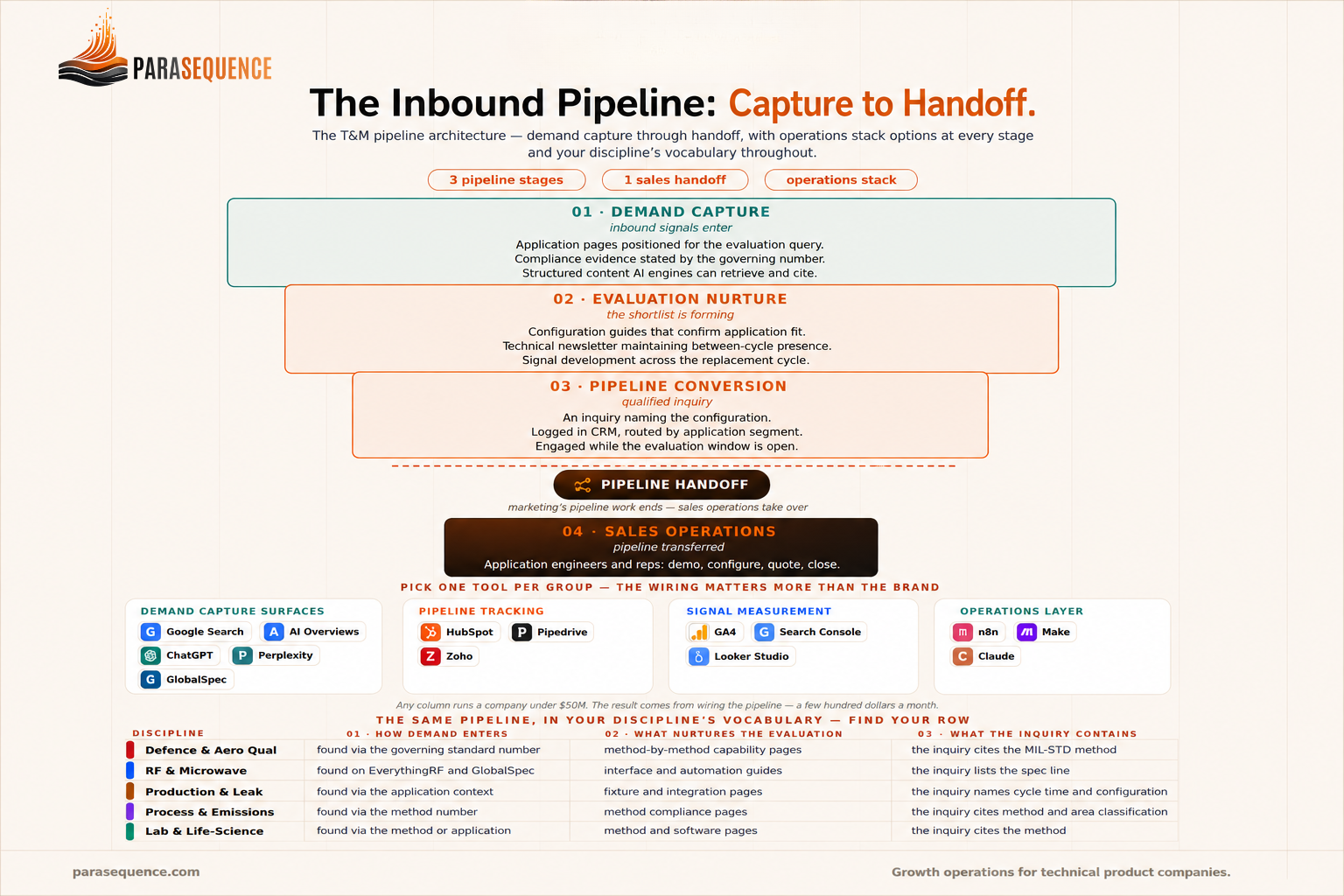
The shortlist forms during this research phase. By the time the buyer contacts a vendor, he has typically narrowed to two or three suppliers and formed a preliminary view. The first phone call is validation — checking application fit, confirming lead time, testing whether the people behind the product understand his use case. He is confirming, not discovering.
| Stage | What the Buyer Does | What He Needs to Find | What You Need in Place |
|---|---|---|---|
| Requirement | Measurement problem arises; engineer defines parameters | Nothing yet — this is internal | — |
| Research | Searches by application, standard, specification. Asks AI engines | Content in his vocabulary, referencing his standard or his spec | Application-organised pages, standards references, HTML specs |
| Evaluation | Reads and compares. Drops vendors whose pages do not answer | Evidence of fit: application notes, configuration guidance | Published application engineering knowledge |
| Validation | Calls the shortlist. Internal review begins | Responsive application engineering; materials for the champion | Prepared application engineers; champion-ready pages |
| Decision | The sign-offs land — two at a small customer, five at a prime. Order placed | Total cost, lead time, references | Clear commercial terms |
Notice where the inquiry arrives: past the midpoint. Everything before it — requirement, research, evaluation — happens without you, and it is where most of the selection actually occurs. That early, invisible half of the journey is a marketing problem. The half after the call belongs to your application engineers and your reps.
The rest of this guide is about the half you are not seeing.
The buying journey above is the buyer's side of the process. Your marketing funnel is the same process seen from your side — and in this sector it has a specific shape, because instrument purchases are episodic.
A company does not buy a thermal chamber every quarter. Test equipment is a capital purchase on a replacement-and-expansion cycle measured in years — three to seven is the range most makers will recognise, and your own service records will tell you where you sit. That one fact sets the arithmetic every instrument maker should run on their own numbers:
Sites that could use your instrument ÷ replacement cycle in years = accounts genuinely in-market this year.
Four hundred addressable sites on a five-year cycle is roughly eighty accounts in-market this year — six or seven a month, spread across every environment you serve. Everyone else is a future buyer. A funnel built for this reality has two jobs at the top: be found by the six who are searching this month, and be remembered by the hundreds who are not — yet.
| Funnel Stage | Buyer's Journey Stage | What Happens | Whose Job |
|---|---|---|---|
| Awareness | Requirement → Research | An engineer with a fresh measurement problem lands on your application note, standards page, spec table or portal listing | Marketing |
| Engagement | Research → Evaluation | He returns, reads the second page, downloads the configuration guide, subscribes to the newsletter | Marketing |
| MQL | Evaluation → Validation | The account shows buying evidence and the inquiry arrives | Marketing → handoff |
| SQL and beyond | Validation → Decision | Application engineering calls, demos, quotes, final review | Sales and application engineering |
The first touch in this sector is almost never your homepage. It is a technical page answering a specific question — which is why the content half of this guide matters more than the brand half.
“Marketing qualified lead” only means something if you define it in your own terms. For an instrument maker, real qualifying signals look like:
A single brochure download is not an MQL. Neither is a generic contact-form message. Counting those as leads is how a funnel looks healthy while producing nothing.
Marketing's funnel ends at the MQL. From there the application engineer and the rep carry the deal — demos, configuration, quoting, the order meeting. That downstream machinery (CRM stages, quote follow-up, sales automation) is its own system and deserves its own attention; this guide stops at the handoff, because everything up to it is what marketing controls.
The top of the funnel is won or lost on visibility — and in this sector, visibility runs through three mechanisms that all reward the same underlying asset.
Generic SEO advice says to target high-volume keywords. Instrument searches invert that: the valuable queries are low-volume and high-intent, built from application, standard or spec, and constraint — the query shapes from the journey section. Nobody idly searches “partial discharge measurement IEC 60270.” The searcher has a requirement and often a budget.
This changes what “doing SEO” means for an instrument maker. It is not chasing volume; it is holding a complete map of the applications you serve and the standards or parameters that govern them, and making sure a page exists — in plain HTML — for each one that matters. Your search console data then reads like a sales report: which standards, which applications, which environments are pulling.
Where that visibility is won shifts by family. EMC, vibration, chambers, materials testing and the method-driven analytical families are found through the governing number. Bench, RF, DAQ and sensor makers are found through the spec line — and RF lives on the portals as much as on Google. Production test is found through the application. Calibration equipment is found through the stated uncertainty. Your family’s row from the start of this guide tells you which battle to fight first.
Engineers increasingly put the question to an AI engine first — then verify the answer against the supplier's own pages.
The mechanism is worth understanding, because it is not magic. The engines assemble answers from pages they can retrieve and parse: some pull from a search index, others run live web searches weighted toward fresh, structured content. Either way, what gets surfaced is determined by what exists in machine-readable form — specifications in HTML rather than locked in PDFs, applications described in the buyer's vocabulary, standards named by number, claims specific enough to stand alone.
We ran six real buyer questions — RF, EMC, bench automation, production and leak test — through the engines in August. Six for six, the citations went to teaching content — buying guides, application notes, standards explainers — with no visible preference for vendor size. Six questions is a sample, not a study; but the mechanism behind it is not in doubt. The engines do not know who the market leader is. They know who published the clearest answer.
The six, and who got named
That is the levelling mechanism in AI search, and it favours the smaller instrument maker for exactly as long as the bigger ones keep their knowledge in PDFs.
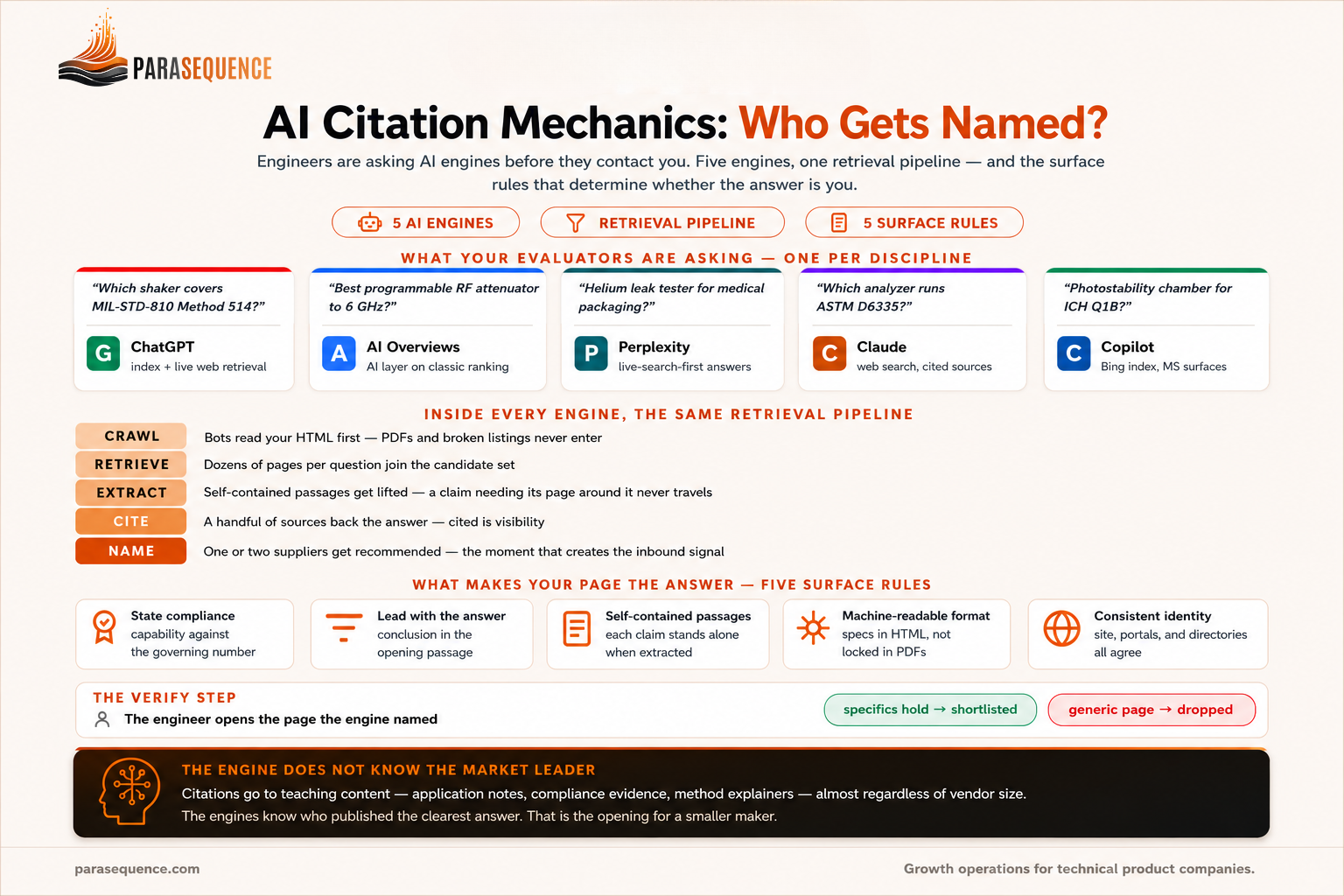
One distinction matters when you check your own visibility: being cited (your page is a footnote) is not being named (the answer recommends you). And the verify step is where it converts — when an engine names a supplier, the engineer opens the page and checks whether the answer holds up. If the page confirms it with specifics — the right standard, the right application, the right operating conditions — you stay on the list. If the page is generic, he moves on.
The same failures defeat both search engines and answer engines:
The directories close the loop: a complete GlobalSpec or EverythingRF listing is both a channel in its own right and third-party corroboration that strengthens how the engines treat everything else you publish.
The answers that close instrument sales already exist inside your company. An application engineer has explained how the product fits a specific use case dozens of times — by phone, after the buyer already built a shortlist.
That knowledge — application fit, configuration for specific environments, failure modes, honest boundaries — is the company's strongest sales asset, and in most instrument companies it is almost entirely unpublished. Publishing it does not replace the application engineer. It changes when his expertise reaches the buyer: during the research phase, when the shortlist is still forming, instead of after it has formed without you.
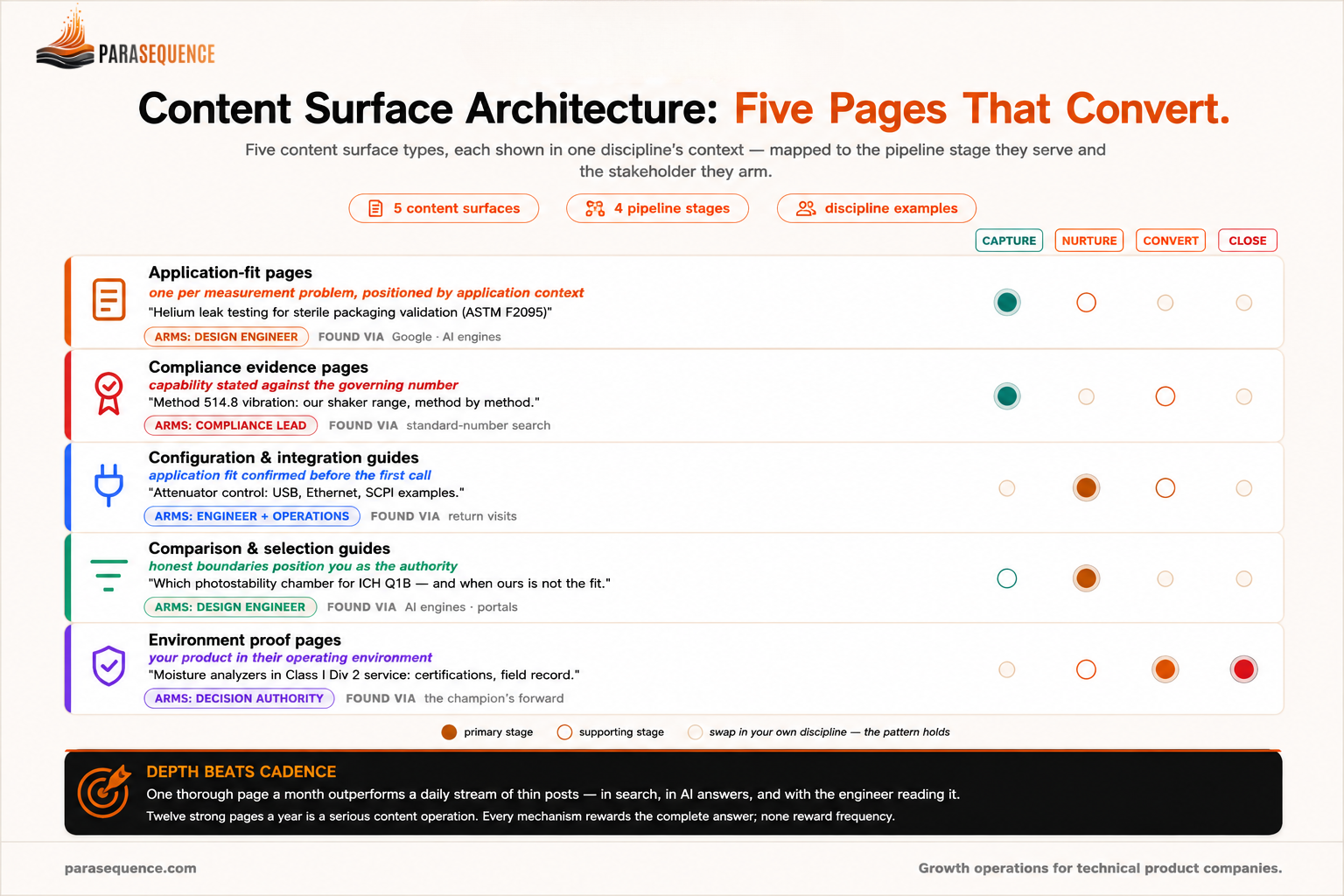
If you build only one page this quarter, your family decides which:
A note on volume, because the content-mill era makes it necessary: one thorough application note a month, written from real application engineering, outperforms a daily stream of thin AI-generated posts — in search, in AI answers, and with the engineer who reads it. Every mechanism in the previous section rewards the page that answers completely. None of them reward frequency for its own sake.
For a company publishing from real expertise, twelve strong pages a year is a serious content operation. Most competitors will not sustain even that.
Search captures the buyer who is already looking. The rest of the system works on the ones who are not looking yet — and on the channels this sector has always run.
The corporate launch post announcing your new chamber does little. The post that works is the one your application engineer writes about a fixturing problem he solved last week — because engineers follow people who talk about their problems, not companies that talk about themselves.
A workable rhythm for a small instrument maker: the company page as the archive, one or two substantial posts a week drawn from real application work, and the technical staff encouraged to carry them. Consistency over months beats a launch-week burst — the audience you are building is mostly not in-market yet, which is exactly why you are building it.
Because purchases are episodic, most of your audience at any moment is between purchases. Email is how you stay present for the years in between — and it splits into two very different motions:
The newsletter is for people who asked to hear from you. Engineers do subscribe to technical newsletters — it is one of the ways they stay current — and a monthly note carrying a real application article earns its place in the inbox. When the replacement cycle comes around, the vendor who has been usefully present for two years gets the RFQ.
Cold outbound is a different machine with different physics, and it must never run on your main domain. One badly-run cold campaign can damage the sending reputation of the domain your quotes and support mail go out on. If you run outbound, it runs on separate secondary domains, on verified addresses only, at low volume per mailbox — deliverability is a physical constraint, not a preference. Done properly, it is how you reach the named engineer at a target site who was never going to find you first.
This sector already has working channels: the regional shows, the manufacturer's reps, the distributors. Nothing in this guide replaces them — the system multiplies them.
The mechanics: the list you built books meetings before the show instead of hoping for booth traffic. The application note answers, at scale and forever, the question every booth conversation starts with. Your reps close faster when the champion can forward a page instead of paraphrasing a memory. And the years between shows — which is most of the time — belong to search, the answer engines, and the newsletter.
The channel mix leans differently by family: RF and component makers get outsized returns from portal listings; qualification-equipment makers from standards visibility and the prime-contractor ecosystem; production-test makers from application notes reps can forward; bench-instrument, sensor and gage makers from catalogue completeness and distributor presence; analytical makers from method pages and the distributor catalogue; power-test makers from utility reference installations and the shows those engineers attend. Same system, different first lever.
Enterprise marketing tools assume an enterprise marketing department. A company with one marketing manager — or a founder wearing the hat — needs the function, not the enterprise contract. This is the stack pattern that fits:
| Function | What It Must Do | Right-Sized | Skip at This Size |
|---|---|---|---|
| CRM | Track accounts, contacts, deals; log quotes and calls | HubSpot Starter, Pipedrive, Zoho | Salesforce |
| Prospect data | Find named engineers and ops leads at target sites | Apollo, Kaspr, ZoomInfo Lite | Full ZoomInfo contracts |
| Cold outbound | Separate sending infrastructure, warmup, verification | Instantly or Smartlead, on secondary domains | Outreach, Salesloft |
| Newsletter / nurture | Subscriber list, monthly technical note, basic automation | Brevo, Mailchimp, MailerLite, or HubSpot's included email | Marketo, Pardot |
| Analytics | See which applications and standards pull, and from where | GA4 + Search Console + Looker Studio | Enterprise BI, intent platforms |
| Ops and content hub | One place where the content map, calendar, and drafts live | Notion or Coda | Heavyweight CMS/DAM suites |
| AI layer | Research, drafting, enrichment, reporting — wired to the tools above | A capable AI assistant connected to your stack | Custom AI platform builds |
Two things about this table.
The economics: the entire left-hand column runs a few hundred dollars a month — less than the carpet at one regional trade show. At this company size the binding constraint is never licence cost. It is operator time and system design: the tools only compound when someone wires them into one system and runs it.
The durability: tools change; the functions do not. When a vendor in this table is superseded, evaluate the replacement against the function column — that is the part of the table that will still be true in five years.
Most marketing measurement advice assumes a short cycle and a high-volume funnel. Instrument marketing has neither, so the standard dashboards mislead. What actually tells you the system is working:
Last-click attribution on a nine-month, multi-person purchase credits the final brand search and erases the application note that started everything. Traffic volume without inquiries measures publishing, not marketing. And a lead count padded with brochure downloads will flatter every report while the pipeline stays empty.
One more check worth an hour a month: run the questions your buyers ask through the AI engines and record whether you are cited, named, or absent — the same way you once checked your Google rankings. That is your share of voice in the channel that is forming right now.
Three numbers watched honestly beat thirty dashboards. A monthly read of the list above, and a quarterly look at direction, is enough measurement for a company this size — provided someone acts on what it says.
The first question worth answering: when an engineer in your target environment searches for the application your product serves — or asks an AI engine — does he find you during the research phase, or only after he has built a shortlist without you?
You can answer it this afternoon, without a budget:
That sequence is also, not coincidentally, the conversation this guide was written to open. It is a question about where your technical depth is reaching the market, in what form, and at what point in the buyer's evaluation.
If you make test and measurement equipment and that question is worth ten minutes, we are at hello@parasequence.com.
This guide is part of a sector-by-sector series on B2B marketing for technical product companies. Written by the Growth Operations Team at Parasequence.
We will show you where the shortlist forms in your category — the queries, the standards searches, the AI citations — and exactly where your instruments are absent. Request the audit.
Request the Audit